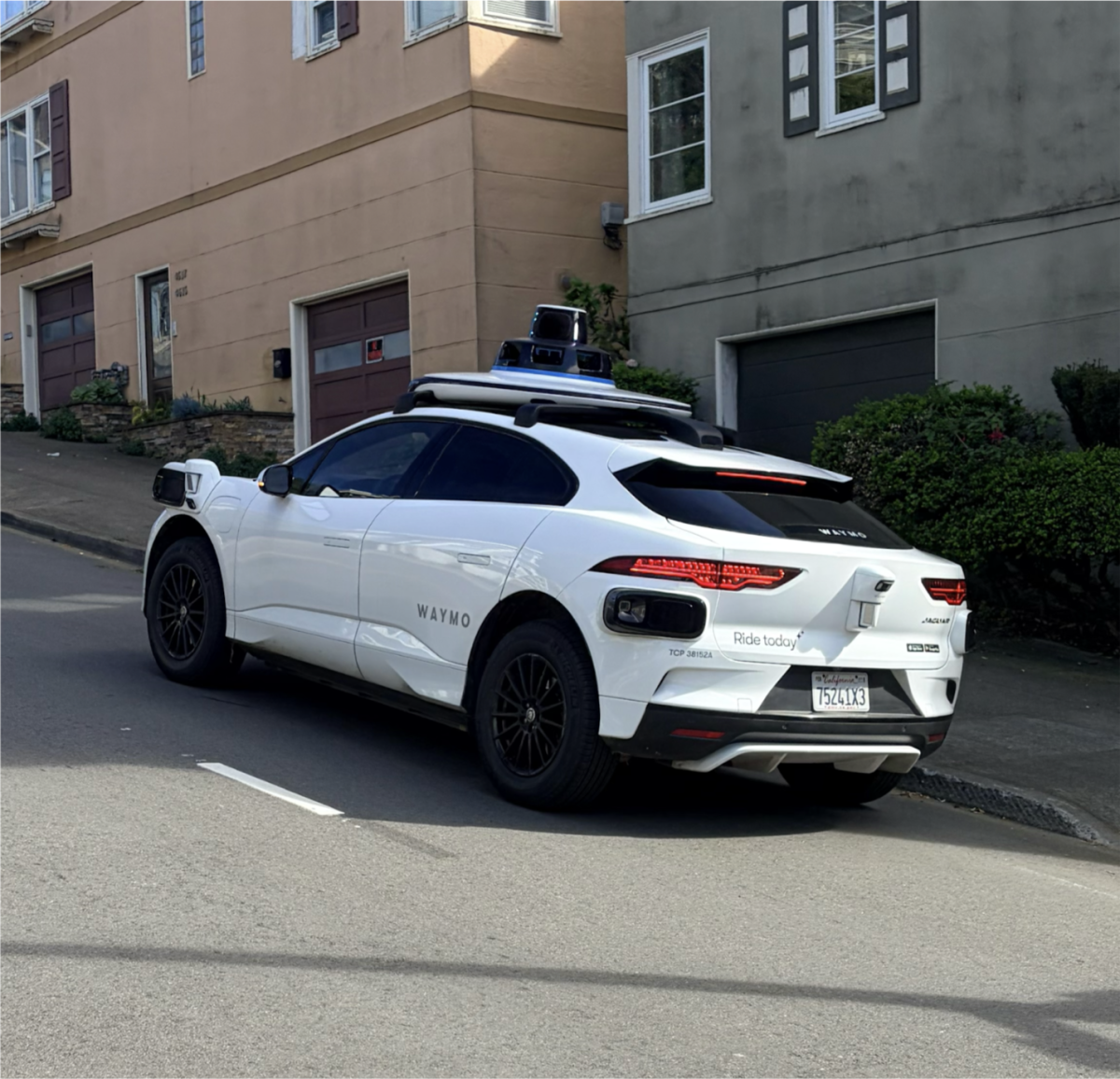
Over the past few years, autonomous taxis have taken over San Francisco, namely Waymos. These cars have taken the alias of ‘robot chauffeurs,’ since they have been used by parents to deliver their teens to school. However, because Waymo does not supervise or enforce any strict rules, minors are legally not allowed to travel in these taxis alone.
Due to the fact that there is no driver present, which avoids unsafe interactions with drivers, Waymo is seen as a safer alternative compared to Uber and Lyft. Many high school students, including those from SHC, have started taking Waymos to school. While the interior camera may not notice that someone is under 18, from time to time tech support representatives question the age of passengers through the car’s interface.
Because San Francisco is known as the ‘epicenter of autonomous vehicles,’ many argue that teen use of Waymos should be legal. So far, Phoenix, AZ is the only city where Waymo has introduced teen accounts. Besides liability issues, local forces in SF such as the San Francisco County Transportation Agency (SFTCA), are fighting to keep the prohibition. SFist reports, “The San Francisco County Transportation Authority submitted comments in October to the CPUC [California Public Utilities Commission] saying that, ‘given the nascent state’ of the autonomous vehicle industry, prohibitions on teen use should continue for now.” The SFTCA wants Waymo to develop their program even further, explaining that teen accounts should be a final step.
A parent describes to the SF Standard that letting their child into a Waymo “felt like a baby’s first steps, that it was a life-changing moment full of ease”. Within the SHC community, Hudson Newhouse ‘27 opposes, “[Taking Waymos] is good, but I would rather take the bus because it is as fast and free.” The cost is definitely higher than Uber or Lyft.
Ms. Chern, Instructor of Physics, believes, “High schoolers are more capable of dealing with Waymo technical difficulties if necessary, and taking Waymos avoids making small-talk with drivers.” Ms. Chern’s freshman physics class currently involves a unit related to how self-driving cars can come to a safe stop. According to the Chronicle, an argument that more parents have made is that there is no one who will hurt their child during the ride, an ever-present fear pertaining to rideshares. Uber launched a teen program in 2023, which targets 13-17 year olds, who need consent from a parent in the app where teens are paired with the top rated drivers. Even so, this may still involve strange conversations and interactions between complete strangers.
Waymo has also been competing with Muni regarding ridership. While Muni has been facing obstacles relating to debt and future budgeting, Waymo has been able to expand its range to both SJC and SFO airports, and most of South Bay. In terms of going national, Waymo has additionally expanded to Phoenix, Los Angeles, Austin, Atlanta, and is planning on expanding to Miami. With Muni’s repetitious safety issues concerning operators, Waymo is now in the transportation spotlight. If the unaccompanied minor protocol stays in place, SF teens may see changes, such as banned Waymo accounts. Ultimately, San Francisco must decide whether or not teens will be left behind as modes of transportation evolve.