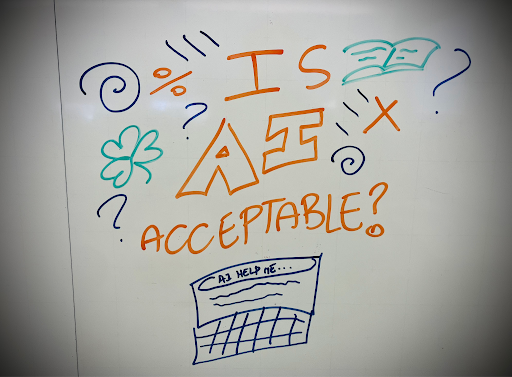
Most students are aware that teachers are averse to the use of artificial intelligence (AI), however, students sometimes still rely on AI to finish schoolwork, avoid late nights, and even for entertainment purposes outside of school. With such a powerful tool in students’ hands, teachers are left to decide if and when AI should be used in the classroom, a decision that largely comes down to what subject the teachers are instructing. As sophomores at SHC, we interviewed four teachers, two math teachers and two English teachers, in order to identify the similarities or differences in their perspectives on AI.
Ms. Mendiola shares, “I often think about a line from the original Jurassic Park film from Jeff Goldblum’s character, ‘You were so preoccupied with whether or not you could, you didn’t stop to think if you should.’” Her reference from Jurassic Park highlights a broader concern: just because we have AI does not always mean we have to use it.

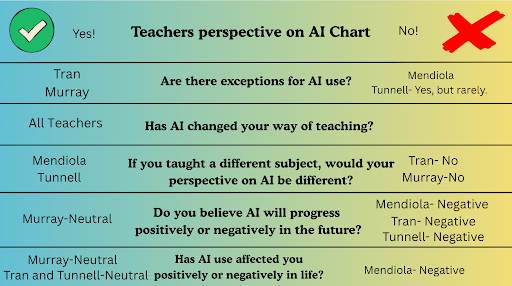
When interviewing English teachers, we found that they appeared more hesitant to implement AI because much of the work relies on students’ personal preferences, critical thinking, and creative voices. Moreover, AI can weaken a student’s ability to analyze and interpret texts, form arguments, and make original ideas. During interviews with Ms. Mendiola and Ms. Murray, they shared their opinions on the topic, representing what some English teachers think.
Ms. Murray, who teaches AP English Literature and is the Director of Learning Innovation, believes that artificial intelligence has both positives and negatives. She pointed out the importance in balancing when to use AI as a tool and when to back away and utilize one’s own cognition. She provided her experience with AI explaining, “I enjoy the labor of curating some of those things myself and am not ready to use AI to do that work for me. For school, though, part of my job is knowing what’s going on in the AI world and sharing that with teachers. That also means using it with my students.”
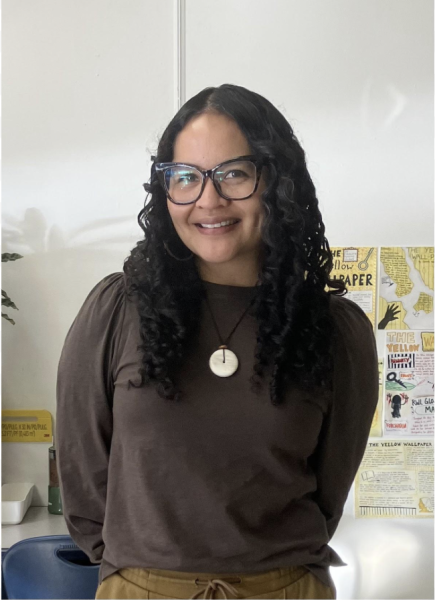
Ms. Mendiola, on the other hand, focused on the drawbacks of AI. She expresses concern about how powerful and persuasive writing from AI can be, especially in the English Department. She believes that students should voice their own opinion and perspective when writing, and worries that AI may hinder intellectual growth because AI is “thinking” for them. She told us, “AI cannot replace something that is so innately human…one of the many things that makes learning so rewarding is the satisfaction of accomplishing a difficult task.”
Mr. Tran shares, “Many students lack a basic math foundation, so when using AI, they might not understand what is being shown to them at all.” Most students need that student-teacher interaction to understand why and how each problem is solved, not just finding the answer through AI.
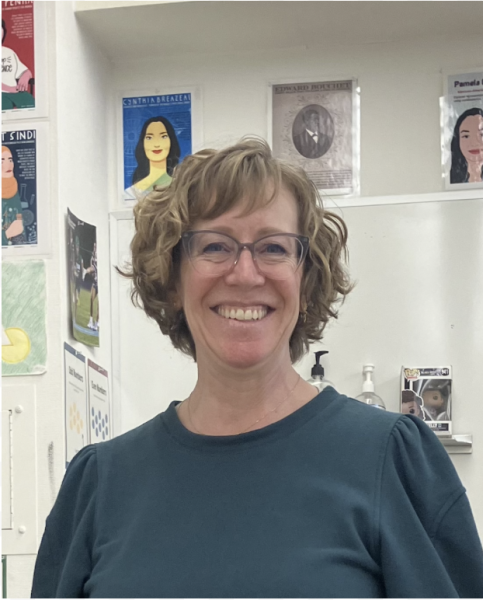
In contrast to the English teachers, the math teachers were more neutral towards AI. Since math often has concrete answers and structured processes, AI serves as a step-by-step guide for students, meaning it does not replace personal expression. However, their neutrality doesn’t hide their underlying concerns. Ms. Tunnell, a geometry teacher new to Sacred Heart Cathedral, points out that AI cannot always be trusted. The sources AI pulls from can be inaccurate and unreliable, and students will not be able to check the information. Still, she does touch on a different aspect of AI in sharing a personal story: “When I was interviewing for the job last year with Dr. Cannon, I was nervous, and this was the first time I ever used ChatGPT. I said, ‘Give me potential interview questions and answers,’ and it actually helped me prepare.” By sharing this story, Ms. Tunnell acknowledged the benefits AI can have when used responsibly. She wants to put herself in the shoes of her students, trying to look through their perspective on each assignment’s difficulty. If it’s challenging, she understands the use of AI as assistance; however, she fears students will take this tool and use it carelessly.

Similarly, Mr. Tran discussed AI’s strengths and weaknesses. He believes AI can provide the wrong answers and complicate already confusing problems. He does not rely too much on it, claiming that he has to double-check if the AI responses are even accurate. He also mentions that students lose that personal connection with their teachers when they turn to AI, as teachers want students to retain the information, while AI seems to only give answers and no additional assurance or guidance. Furthermore, AI’s process to get the answer may sometimes be different from the lesson plan, potentially confusing students further. Mr. Tran believes that though AI is good for short-term use, long term use can affect a student’s perseverance and work ethic, furthermore preventing them from having to navigate through challenges. While he believes AI can be unreliable, Mr. Tran is still neutral to AI in education because it has affected him in both positive and negative ways since he uses AI to help him in day-to-day life.
AI remains a controversial topic among teachers at SHC. It can definitely be useful, quick, and accessible, but it can also be inaccurate and hinder students from learning independently. As AI technology advances, debates on whether or not it should be utilized may change the manner in which teachers and students work together. The question still remains on how we can allow support from AI without it impacting critical thinking in navigating through difficulties in the classroom.